Explain the Purpose of Different Types of Static Routes
To create a default static route on R1 we need to use the following command. No overhead on router CPU.
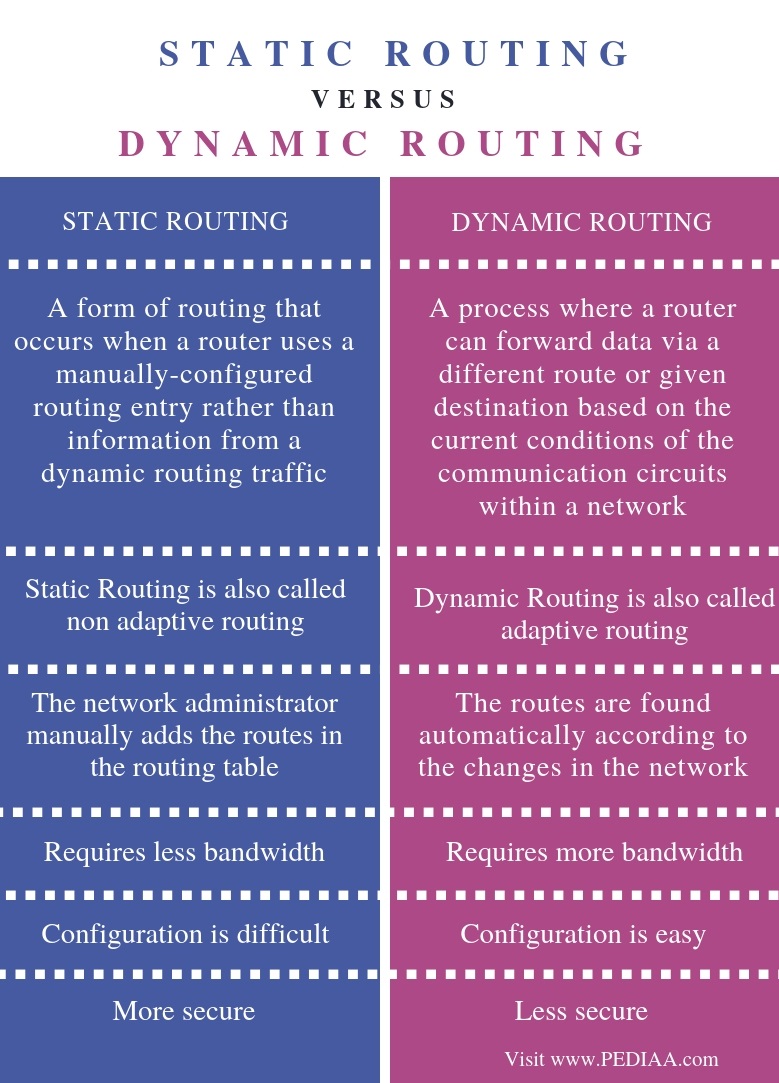
What Is The Difference Between Static And Dynamic Routing Pediaa Com
With static routing you as the administrator manually enter the routes and tell the router for each IP network what next hop that traffic should be delivered to.
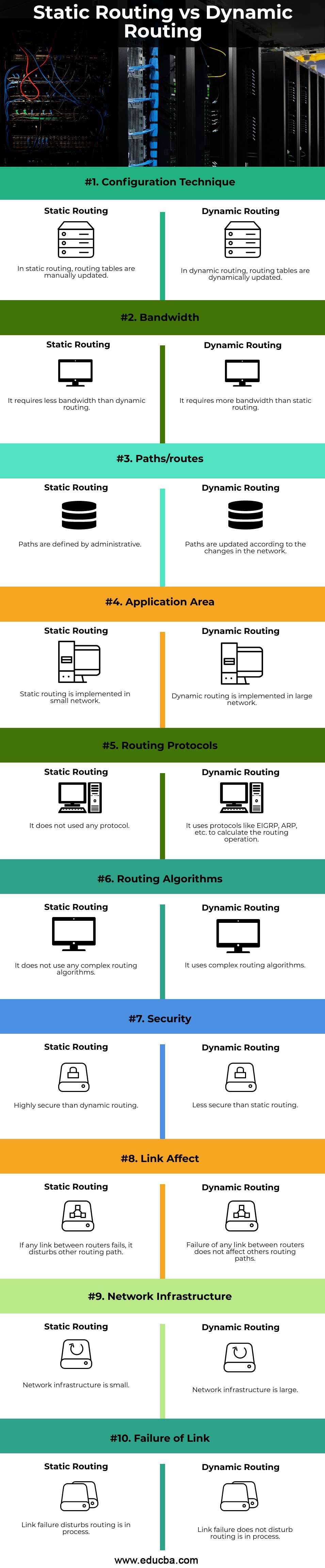
. A Default Route also known as the gateway of last resort is a special type of static route. If a link fails static route cannot reroute the traffic. It is most secure way of routing since no information is shared with other routers.
Static routing is the manual method of routing and Dynamic routing is the routing that is done with the help of Routing Protocols. Different routes in a specific destination network can be assigned different weights so that one of the routes is used in favor of the other. Disadvantage of static routing.
The mechanism through which the router makes such a decision is known as routing. A stub network is a network accessed by a. Static routing protocols are used when an administrator manually assigns the path from source to the destination network.
Providing ease of routing table maintenance in smaller networks that are not expected to grow significantly. Default Route is the network route used by a router when there is no other known route exists for a. R1configip route 0000 0000 10002.
A Router can send the packets for the destination along the route defined by the administrator. There is one more point related to the static routes problem that is possibility of routing loops creation by mistake. Explain the purpose and usage of different types of static routes 1.
A static route is a route that is manually configured on the router. This type of Static Route identifies traffic based on. There are two types of Static Route entries that may be used depending on the desired effect.
It is suitable only for small network. Advantages Of Static Routing. Default Routing This is the method where all routers are configured to send all packets towards a single router.
Static Routing Protocols. Dynamic routing provides less security. Routing to and from stub networks.
Understanding Dynamic and Static Routing. Using a single default route. The information about the networks that are directly connected to the active.
Providing simple routing table maintenance in smaller networks that arent expected to grow considerably. Static Routing This is the method by which an administrator manually adds routes to the routing table of a router. Static Routing Dynamic Routing.
In static routes the administrative distance is as default value. The command above instructs R1 to match all IP address and subnet masks and send the packets to 10002 the interface on R3 that is connected to R1. When to Use Static Routes Static routing has 3 primary uses.
This type of configuration is usually used in smaller networks. Can you configure IPv4 and IPv6 static routes by specifying a next-hop address. Static routing is a process in which we have to manually add routes to the routing table.
How is legacy classful addressing used in. Where a static route specifies a path a router should use to reach a specific destination a default route specifies a path the router should use if it doesnt know how to reach the destination. There are 3 types of routing.
Upon completion of this chapter you will be able to answer the following questions. A stub network is a network accessed by a single route and the router has only one. Routing is a process that is performed by layer 3 or network layer devices in order to deliver the packet by choosing an optimal path from one network to another.
ADs are used for prioritization purposes. In static routing routes are user defined. Yes that is why we need to use dynamic routing.
It is a technique in which the administrator manually adds the routes in a routing table. It is easy to implement. The static routing may not react to network failures thus the fail could break whole communication.
Your routing protocol learns about other routers automatically. The difference between static route and dynamic route is as below. There are two ways a router learn a route.
Dynamic routing solves the above problems. Can you explain the purpose of different types of static routes. Static Routing is also known as Nonadaptive Routing.
Dynamic routing uses complex routing algorithms. It offers more security to the network. A stub network is a network accessed by a single route and also the router has just one neighbor.
There are two types. Only the administrator is able to add routes. Static routing provides high or more security.
Static routing does not use complex routing algorithms. Static Routes and Static Policy Routes. This type is the optimal path between all possible pairs of sources destinations in the given network is pre-defined and fed into the routing table of the networks routers.
Providing ease of routing table maintenance in smaller networks that are not expected to grow significantly. Static routes are configured manually by typing the global configuration mode command ip route DESTINATION_NETWORK SUBNET_MASK NEXT_HOP_IP_ADDRESS. Simply we can say a static route is a route that is created manually by a network administrator.
It puts no overhead on resources such as CPU or memory. There is also another staatic routes called floating static routes that we can change administrative distance of this routes. In Static routing we can enter all the.
Networking devices share data among themselves with the help of a router a router is a device that learns which paths are available and which path is best to forward traffic to. This is a method for small networks but it is not scalable for larger networks. Advanced Static Routes identify traffic based on destination IP address subnetwork and a source LAN IP address netnetwork on an Ecessa LAN interface.
Routes having the same weight load share the traffic. By adding static routes a router can learn a route to a remote network that is not directly connected to one of its interfaces. No unused bandwidth between links.
Routing to and from stub networks. Routing to and from stub networks. Advantage of static routing.
With dynamic routing you as the administrator configure a routing protocol on your network interfaces. In dynamic routing routes are updated according to topology. What are the advantages and disadvantages of static routes.
Using a single default route to represent a path to any. There is no CPU overhead for the routers to decide the next hop for the packet as the paths are predefined. We will see in practice further on how we can change ADs in.
By default Static routes have an administrative distance AD of 1. In this technique routing decisions are not made based on the condition or topology of the networks. Static routing has three primary uses.

Types Of Routing Geeksforgeeks

Understanding Dynamic And Static Routing Engineering Education Enged Program Section
Static Routing Vs Dynamic Routing Top 10 Differences You Should Know


Comments
Post a Comment